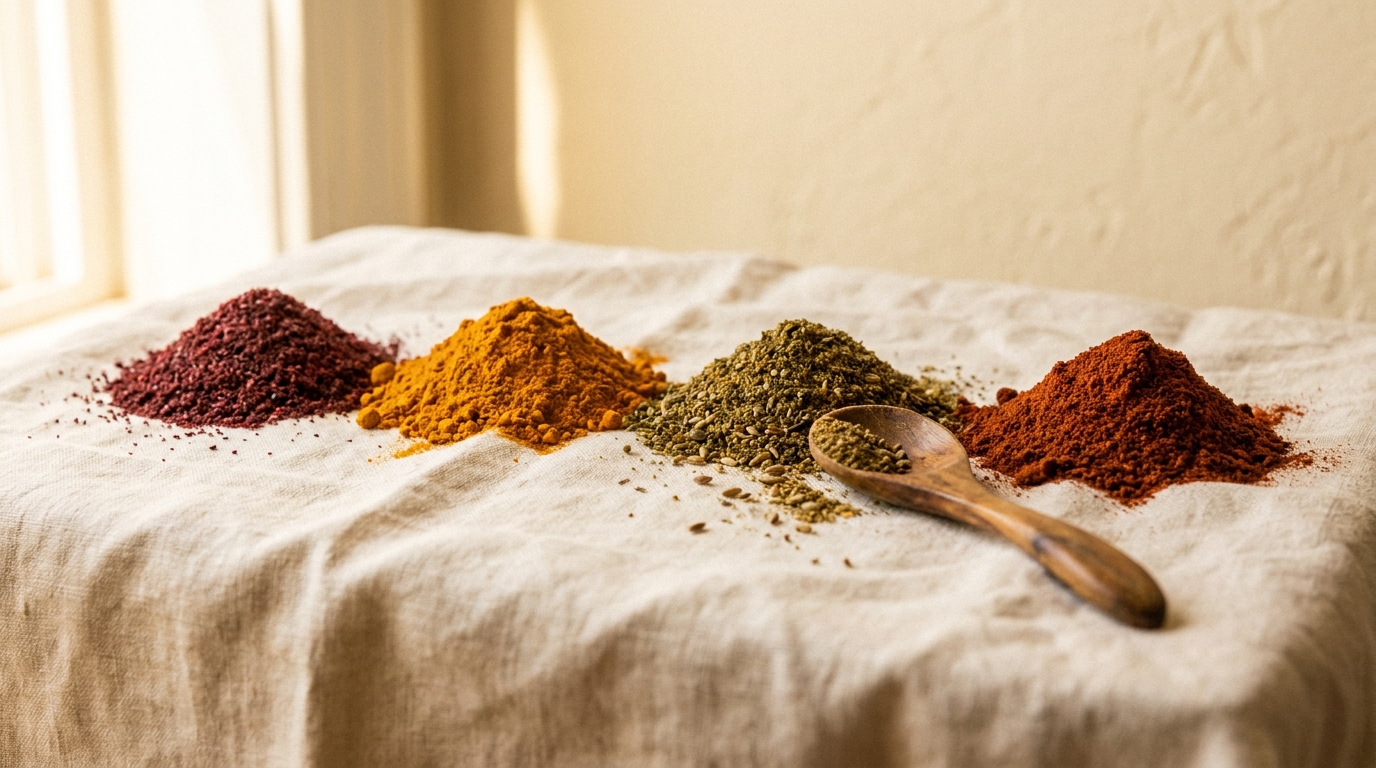
Pomegranate molasses is pomegranate juice boiled down to about a quarter of its volume, until it becomes a thick, dark red syrup that tastes sour first and sweet second. In Arabic it is dibs ar-rumman, and in Turkish nar ekşisi. It is used by the tablespoon in salad dressings, marinades, dips and stews: the fattoush salad on this site whisks 2 tablespoons into its dressing, and fattet musakhan stirs 2 tablespoons into its onions. The word molasses here describes the texture. There is no cane sugar in it, and it is unrelated to the dark syrup left over from sugar refining.
What pomegranate molasses tastes like
It is sharp first and sweet second, with the fruit behind both. The Nosher at My Jewish Learning (Stephanie Ganz, 2021-08-03) describes it as "thick and slightly sweet, with cheek-puckering tartness". Wikipedia's muhammara entry credits it with that dip's "characteristic sweet-tart note".
How sour a particular bottle is depends on whether anything besides juice went into it. Juice that has only been reduced is the sharpest. Plenty of bottles and home recipes add sugar, which pushes the taste toward a fruit syrup. Taste a drop from a new bottle before you measure out a recipe's full amount.
What is pomegranate molasses called in Arabic, Turkish and Persian?
In Arabic it is dibs ar-rumman (دبس الرمان), usually written dibs rumman on labels and in recipes. Rummān is the Arabic for pomegranate, according to Wiktionary. Dibs is the same word used for date syrup, which Wikipedia's date syrup entry lists under the names "date molasses" and "Debes (Arabic: دِبس)".
Wikipedia's pomegranate molasses entry calls it "a Middle Eastern, South Caucasian and Balkan condiment consisting of concentrated pomegranate juice" and gives its other names:
- Turkish: nar ekşisi. Ekşi means sour (Wiktionary), so the Turkish name is closer to "pomegranate sour" than to molasses.
- Persian: narsharab or robb-e anâr. Wikipedia notes that narsharab "literally means pomegranate wine, although it contains no alcohol."
- Azerbaijani: narşarab.
- Armenian: narsharab or nuri matsuk.
- Greek: melása rodioú.
English labels vary as well. A jar may say pomegranate molasses, pomegranate syrup or pomegranate paste, and Wikipedia's fesenjan entry translates narsharab as "pomegranate paste". Alton Brown's Food Network recipe separates syrup from molasses by how far the juice cooks down: 4 cups reduced to 1 1/2 cups, about 50 minutes, is his syrup, and the same pot taken on to 1 cup, about 70 minutes, is molasses.
What exactly is molasses?
Ordinary molasses is "a viscous byproduct principally obtained from the refining of sugarcane or sugar beet juice into sugar", in the words of Wikipedia's molasses entry. Blackstrap, the dark, thick kind, is noticeably more bitter than regular molasses. The word comes from the Portuguese melaço, built on mel, honey.
Pomegranate molasses contains no cane or beet at all. It shares the name because it shares the look: dark, thick and slow off the spoon. That is also why the two cannot stand in for each other. Baking molasses or blackstrap in a fattoush dressing would add sweetness and bitterness and none of the sourness the salad needs.
Pure or sweetened: read the label
Two kinds sit on the same shelf under the same name. One is pomegranate juice reduced and nothing else. The other has sugar, glucose syrup, lemon juice or citric acid added, and some are closer to a pomegranate-flavoured sauce than to molasses.
Sugar is part of the traditional method, too. Wikipedia's description of the traditional method cooks the juice to half its original volume, then adds sugar with coriander, basil and cinnamon, and sometimes black or red pepper. Alton Brown's recipe adds 1/2 cup of sugar and 1 tablespoon of lemon juice to 4 cups of juice. The Nosher's recipe adds neither, and says "all you really need for a tangy pomegranate molasses is juice and time."
Glucose syrup in bottles sold as pomegranate molasses is documented. In a 2010 study in the Journal of Agricultural Faculty of Bursa Uludağ University, Bige İncedayı, Canan Ece Tamer and Ömer Utku Çopur bought seven brands in Bursa, Turkey, and found glucose syrup in four of them. Total sugar across the seven ran from 44.8 to 65.3 g per 100 g.
Turkey now regulates the name. In March 2023 its Ministry of Agriculture and Forestry amended the Turkish Food Codex so that nar ekşisi may contain nothing except pomegranate, pomegranate juice, pomegranate juice concentrate and water. Look-alikes sold as nar ekşili sos (pomegranate sour sauce), narlı sos or pomegranate-flavoured syrup had to be off the domestic market after 2024-06-30. The rule covers sales inside Turkey, so it tells you nothing about what an exported bottle contains.
In the US, the ingredient list is the check. Federal labelling rules (21 CFR 101.4) require ingredients to be listed "in descending order of predominance by weight". A bottle that lists only pomegranate juice or pomegranate concentrate is the pure kind. If sugar, glucose syrup or corn syrup comes first, there is more of that than of pomegranate. Neither recipe on this site says which kind to buy, so taste the dressing or the onions before deciding they need more.
What to add pomegranate molasses to
Anything that wants a sour-sweet note and a little body. Wikipedia gives fish and meat dishes and salad dressings as its usual uses. The Nosher adds Israeli salads, the rosewater pudding malabi, whose sweetness it balances, and baking: in a recipe for date and pomegranate blondies, it says, "just a tablespoon" gives them a pink hue.
In a salad dressing: the fattoush salad
The dressing for the fattoush salad is 1/4 cup of olive oil, 1/4 cup of lemon juice, 2 tablespoons of pomegranate molasses, 4 minced garlic cloves, 1 teaspoon of salt and 1 teaspoon of sumac, whisked together in a small bowl or jar. It is poured over chopped romaine, red pepper, baby cucumbers, cherry tomatoes, green onions, radish, mint and parsley, and the za'atar-baked pita goes in just before serving so it stays crisp.
Put as a ratio, that is 1 part molasses to 2 parts lemon juice and 2 parts oil. The same proportions make a usable starting dressing for any crisp salad, adjusted to taste.
The recipe treats the molasses as optional. Its introduction says pomegranate molasses, "if you have it, adds a sweet-tart depth", and its FAQ says that without it you should "lean on extra lemon and sumac for tang."
Cooked into onions: fattet musakhan
In fattet musakhan, 1 kg of thinly sliced red onions cook slowly in 1/2 cup of olive oil over medium heat until deeply caramelised, which the recipe's FAQ puts at 25 to 35 minutes. The molasses goes in only after that: 2 tablespoons, with 4 tablespoons of sumac, 1 teaspoon of cumin, 1/4 teaspoon of cinnamon, salt and black pepper, stirred until the onions are coated. Then 1 kg of boiled, shredded chicken is mixed through.
That mixture is spooned over crisp pita squares and a yogurt and tahini sauce, then finished with toasted pine nuts or slivered almonds, parsley and, if you are using them, pomegranate seeds. With the seeds, the fruit appears twice in the dish: reduced into the onions, and fresh on top.
Other dishes that use it
- Muhammara, the walnut and red pepper dip from Aleppo, which Wikipedia lists as walnuts, red peppers, pomegranate molasses and breadcrumbs.
- Fesenjan, which Wikipedia describes as "a sweet and sour Iranian stew" flavoured with narsharab and ground walnuts.
- Batinjan bil rumman, which The Nosher calls "a classic pairing of eggplant and pomegranate from Lebanon".
How to make pomegranate molasses
The standard method takes one ingredient and about an hour. In The Nosher's version, you bring 32 oz (4 cups) of pomegranate juice with no added sweeteners to a simmer and keep it there "for about 1 hour until it coats the back of a spoon." It yields 1 cup, so the juice loses about three quarters of its volume.
Alton Brown's recipe is the sweetened version. The 4 cups of juice, 1/2 cup of sugar and 1 tablespoon of fresh lemon juice go into a 4-quart saucepan over medium heat until the sugar dissolves. Then the heat drops to medium-low until the liquid is down to 1 cup, about 70 minutes, with "the consistency of thick syrup". It cools in the pan for 30 minutes before it is moved to a glass jar.
How to tell it is done:
- Check the volume. Both recipes finish at 1 cup from 4. If the level in the pan is hard to read, pour it into a heatproof measuring jug and look.
- Dip a spoon. The syrup should coat the back of it rather than run straight off.
- Look at it cold. What you see in the pan is the hot texture, and it sets thicker as it cools. The freezer test the National Center for Home Food Preservation gives for jelly works as a preview: put a small amount on a plate in the freezer for a few minutes, then check it.
Watch the last stretch. The Nosher warns that "if it goes too far, you'll lose the essential anthocyanins", the pigments behind the fruit's colour and its astringent taste.
To start from fresh fruit, The Nosher puts 32 oz of juice at 6 to 8 pomegranates. Utah State University Extension gives a quarter to half a cup of juice per large pomegranate, which would put 4 cups at 8 to 16 fruit, so buy more than the lower figure. Utah State presses the seeds through a sieve or food mill, or blends them 1 1/2 cups at a time and strains the juice. For seeds headed to the juicer, the halve-and-tap method in the guide to cutting a pomegranate is the quick one, since broken seeds don't matter.
How to store pomegranate molasses
Keep an opened bottle in the fridge, as the pantry staples guide on this site says for both tahini and pomegranate molasses. Homemade molasses keeps in the fridge in a glass jar for up to 6 months, according to Alton Brown's recipe, and The Nosher says simply "for months". For a bought bottle, follow the date and storage line on its label.
Cold molasses is stiff. Take it out a few minutes before you measure, or stand the jar in a bowl of warm water.
What can I use instead of pomegranate molasses?
Nothing tastes quite the same, because the flavour is pomegranate. A substitute can copy the sour-sweet balance and some of the thickness, and which one works depends on the dish.
- Make it. If you can find pomegranate juice with nothing added, an hour on the stove gives you the real thing, using the method above.
- Extra lemon and sumac, for a salad. The fattoush recipe suggests exactly this. You keep the sourness and lose the sweetness and body.
- Tamarind paste or concentrate. Wikipedia describes tamarind pulp as "sweet and sour in taste" and says that from the Levant to Iran it goes into savoury dishes, notably meat stews. It brings sourness and body, but it tastes of tamarind and turns a dish brown rather than red. Concentrates vary in strength, so start with half the amount and taste.
- Balsamic vinegar, simmered down with a little sugar or honey. Balsamic is made "wholly or partially from grape must", per Wikipedia, so it is dark and fruity, but it tastes of grapes and vinegar. It suits a dressing better than muhammara or fesenjan, where pomegranate is the point. Bottled balsamic glaze often carries added sweetener and thickener, so it is sweeter again.
- Lemon juice with honey or sugar. It gets the sweet and sour, but it is thin and tastes of lemon. It works best in a marinade, where texture matters least.
Two things to leave on the shelf. Grenadine was "originally prepared from pomegranate juice, sugar, and water", says Wikipedia's grenadine entry, but it describes the most common US brand as high-fructose corn syrup, water, citric acid, sodium citrate, sodium benzoate, two colourings and flavourings, with no pomegranate in the list. Even a homemade grenadine is a different product: Utah State's recipe is 4 cups of juice with 2 cups of sugar, simmered for 3 to 5 minutes, so it is far sweeter and barely reduced. Regular and blackstrap molasses, as above, bring bitterness and no sourness.
Some recipes can do without it. In fattoush it is optional by the recipe's own account. The fattet musakhan recipe offers no swap for it, but its introduction credits sumac with the dish's "signature sourness", and the 4 tablespoons of sumac stay in the onions whether or not the molasses goes in.
New here? Read Why I Started Simply by Maha.